
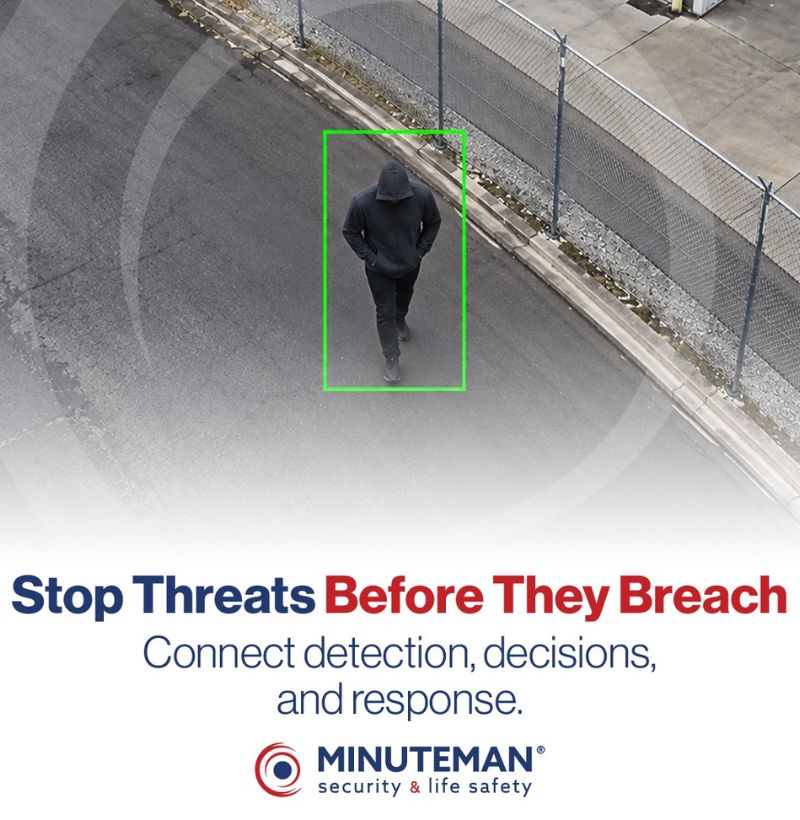
For years, perimeter security was largely defined by a physical boundary. Protect the fence line. Control the gates. Install cameras. Detect someone attempting to enter a protected area and respond.
Today’s threat environment is far more complex.
Threats are evolving across multiple vectors. Unauthorized personnel and vehicles remain concerns, but organizations must also consider coordinated attacks, insider or assisted breaches, drones, blind spots in coverage, sensor overload and the speed at which security teams can identify and respond to a legitimate threat.
That requires us to think differently about what a perimeter is—and what it means to actually defend it.
The Perimeter Doesn’t Stop at the Fence
A perimeter is the physical border surrounding the people, infrastructure, systems and assets an organization needs to protect. But that border doesn’t necessarily end at a fence or even at the walls of a building.
Think of the perimeter as six-sided: north, south, east and west, but also below and above. Depending on the environment, threats may come through a fence line, gate or other traditional entry point, but they may also come through below-grade access or overhead airspace.
In other words, the perimeter includes anything that allows access into or out of a protected space.
As the perimeter has evolved, so have the technologies available to protect it. Radar, LiDAR, thermal and optical cameras, RF detection, analytics, AI and other technologies can provide organizations with levels of awareness that weren’t possible in the past.
But adding more technology doesn’t automatically create a more secure perimeter.
Fragmented Systems Lead to Perimeter Failure
One of the biggest challenges I see isn’t necessarily a lack of security technology. It’s that many of those technologies operate independently.
An organization may have cameras, intrusion detection, access control, radar and analytics, each performing exactly as designed. But if the information those systems generate isn’t correlated and acted upon quickly, the organization may still be vulnerable.
Most systems are fragmented and reactive. And that can lead to perimeter failure.
A sensor detects something. An alert is generated. Someone needs to determine whether it’s legitimate. An operator looks for the corresponding camera. Additional information needs to be gathered. Someone determines who should respond.
Meanwhile, the threat keeps moving.
Security is a system, not a set of tools.
The objective shouldn’t be to collect more alerts. It should be to provide the right information, at the right time, to enable the right response.
Organizations don’t necessarily need more sensors. They need coordination.
From Detection to Prevention
The goal of perimeter security isn’t simply to detect activity. The goal is to provide adequate time, intelligence and methodology to prevent a breach.
That’s the idea behind Intelligent Perimeter Defense.
Rather than evaluating perimeter security as a collection of products, we look at it as a coordinated defense system with five interconnected layers:
Detection → Classification → Decision → Response → Command
Detection: Eliminate Blind Spots
The first layer is awareness.
Radar, LiDAR, thermal and optical cameras, RF detection and other technologies can provide coverage across different parts of the perimeter and under different environmental conditions.
No single technology is necessarily the answer for every application. The objective is to design multi-sensor coverage appropriate for the environment so the organization has the earliest possible awareness of activity.
But detecting something is only the beginning.
Classification: Turn Data Into Understanding
Once activity is detected, the system needs to help determine what it means.
Is it a person? A vehicle? Wildlife? A drone? Is the behavior expected, or does it represent a potential threat?
AI, analytics and sensor fusion can correlate information from multiple technologies, distinguish legitimate threats from noise and significantly reduce false positives.
This becomes increasingly important as organizations deploy more sensors. More detection without better classification can simply create more alerts for operators to manage.
The objective is actionable intelligence—not more data.
Decision: Determine What Should Happen
Once a potential threat has been identified, the next question is what action should be taken.
Threat scoring, rules engines and automated workflows can help prioritize events and establish the appropriate course of action based on the nature and severity of the threat.
This is where intelligent perimeter defense begins to remove some of the hesitation that can occur when operators are forced to interpret multiple pieces of information under pressure.
The system should help people make faster, better-informed decisions.
Detection Without Response Is Just Noise
Ultimately, identifying and understanding a threat only matters if an organization can do something about it.
Speed + coordination = prevention.
The response layer closes the gap between detection and action. Alerts need to reach the proper parties, security technologies need to integrate with the SOC and platforms such as VMS or PSIM, and established workflows need to initiate the appropriate response.
Depending on the environment and the nature of the threat, that could involve security personnel, communications, dispatch, physical or electronic countermeasures, or other predetermined actions.
The specific response will vary. The principle doesn’t.
A perimeter defense system should provide enough awareness and intelligence to act before penetration occurs, not simply document what happened afterward.
Command: Bring It All Together
The final layer is command.
A central platform should aggregate information and provide operators with a unified view of the environment. Rather than moving between disconnected applications and interpreting isolated alarms, operators need the situational awareness to understand what is happening and coordinate the appropriate response.
This is where all five layers come together.
Detection creates awareness. Classification creates understanding. Decision determines the appropriate action. Response puts that decision into motion. Command provides unified control of the entire system.
Each layer strengthens the next.
Perimeter Security Requires a Designed System
There are a lot of capable technologies available for perimeter security. There are also a lot of capable integrators that can deploy cameras, access control, sensors and infrastructure.
But there’s a difference between installing security infrastructure and delivering a comprehensive, functioning perimeter defense system.
Technology alone doesn’t solve the problem. System design and execution do.
At Minuteman, our focus is system performance. We bring together the technologies, integrations and expertise required to design a perimeter defense strategy around the customer’s environment and desired outcomes—not around a predetermined list of products.
Because the ultimate measure of perimeter security isn’t the number of cameras installed, sensors deployed or alerts generated.
It’s whether the entire system works together when it matters.
Threats are evolving across multiple vectors. Fragmented and reactive systems leave gaps. Organizations need a coordinated defense system capable of detecting, classifying, deciding, responding and commanding as one.
The desired outcome is simple:
Stop threats before they become breaches.