
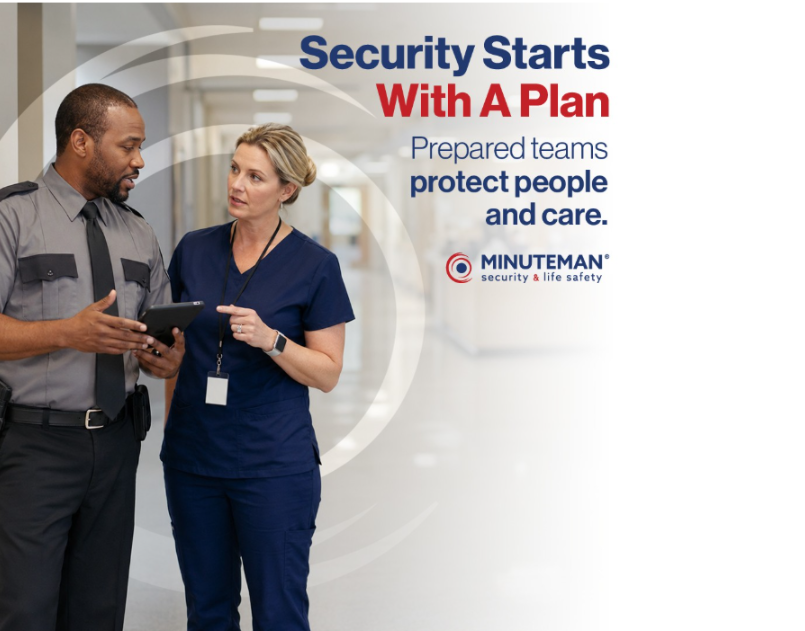
By David White
Community health centers exist to remove barriers to care. They’re designed to be accessible, welcoming, and deeply connected to the communities they serve.
That mission is what makes them so valuable, but it’s also what makes security planning more complicated.
Unlike hospitals with dedicated security departments or corporate campuses with tightly controlled access, community health centers often balance open public access, multiple service lines, limited resources, and growing operational demands—all while trying to create an environment where patients feel comfortable seeking care.
That’s why security today is no longer simply about installing cameras or replacing locks; it’s about operational readiness.
Security Is Now an Operational Responsibility
For many healthcare organizations, security has historically been viewed as a facilities issue. If a camera stopped working or a door reader failed, someone called for service.
Today, security touches nearly every aspect of clinic operations. It affects staff safety, patient experience, emergency preparedness, HIPAA compliance, IT infrastructure, pharmacy security, incident response, and even funding opportunities.
As community health centers continue expanding locations, adding behavioral health services, integrating technology, and serving more patients, security becomes part of how the organization delivers care—not just how it protects buildings.
The question leadership should ask isn’t: “Do we have cameras?” They should ask: “Are we prepared to prevent, detect, respond to, and recover from incidents without disrupting patient care?”
That’s the real definition of security readiness.
Technology Doesn’t Solve Workflow Problems
One of the biggest misconceptions in healthcare security is believing that technology alone reduces risk. A panic button no one remembers to use doesn’t improve safety. A camera that misses a critical angle won’t provide the evidence investigators need. And an access control system with inconsistent permissions can create more confusion than protection.
Effective security begins with understanding how a clinic actually operates. Leadership should first examine how visitors move through the building, who has access to medication storage, how after-hours staff are protected, how disruptive situations are managed, and how quickly incidents can be reviewed and escalated. Only after those operational questions are answered should technology become part of the solution.
The most successful healthcare security programs don’t start with equipment lists—they start with operational workflows that technology is designed to support.
Consistency Creates Better Security
Many community health centers operate multiple locations that have been expanded, renovated, or acquired over time. As a result, it’s common to find different badge systems, visitor procedures, camera naming conventions, and emergency response processes from one clinic to the next. While each location may function independently, that inconsistency makes it more difficult for leadership to manage risk across the organization.
Standardization doesn’t mean every clinic has to look exactly the same. It means decisions are made using a common framework, allowing staff to move between locations with familiar procedures, leadership to review incidents using consistent reporting, and IT teams to support security technology more efficiently. When processes are standardized, organizations reduce confusion, improve training, and create a stronger foundation for future growth.
Progress Doesn’t Require a Massive Capital Project
Improving security readiness doesn’t have to begin with a six-figure technology investment. Many organizations can make meaningful progress by focusing on operational improvements first:
- Review access permissions.
- Update emergency contact lists.
- Test camera coverage under real-world conditions.
- Standardize visitor procedures.
- Remove inactive credentials.
- Walk each facility with leadership to identify gaps.
These practical steps build a stronger foundation while helping leadership prioritize future investments based on actual operational risk rather than assumptions.
Readiness Supports the Mission
Community health centers have one primary responsibility: delivering care to the communities that depend on them. Strong security shouldn’t interfere with that mission; it should support it.
When security is approached as an operational discipline, not just a collection of products, organizations become better prepared to protect staff, safeguard patients, maintain continuity during unexpected events, and confidently support future growth.
The goal isn’t to create a fortress; it’s to create an organization that’s ready.