
Blog
Why More Organizations Are Moving Security from CAPEX to OPEX
By Jack Johnson, Chief Revenue Officer, Minuteman Security & Life Safety
For decades, investing in security technology followed a familiar pattern.
Organizations secured capital funding, purchased new systems, installed the infrastructure, and expected it to serve them for years before the next major investment cycle.
That model made sense when technology evolved gradually. Today, it doesn’t.
Security technology is advancing faster than ever. Artificial intelligence is reshaping video analytics. Cloud platforms continue to introduce new capabilities. Cybersecurity threats evolve daily. Integrations are becoming more sophisticated, and organizations expect their security systems to support broader business operations rather than simply detect and respond to incidents.
The challenge isn’t deciding whether to modernize; it’s now about finding a way to keep pace without waiting for the next capital budget cycle.
Read more…Community Health Centers Don’t Need More Security Products. They Need Better Security Readiness.
By David White
Community health centers exist to remove barriers to care. They’re designed to be accessible, welcoming, and deeply connected to the communities they serve.
That mission is what makes them so valuable, but it’s also what makes security planning more complicated.
Unlike hospitals with dedicated security departments or corporate campuses with tightly controlled access, community health centers often balance open public access, multiple service lines, limited resources, and growing operational demands—all while trying to create an environment where patients feel comfortable seeking care.
That’s why security today is no longer simply about installing cameras or replacing locks; it’s about operational readiness.
Security Is Now an Operational Responsibility
For many healthcare organizations, security has historically been viewed as a facilities issue. If a camera stopped working or a door reader failed, someone called for service.
Today, security touches nearly every aspect of clinic operations. It affects staff safety, patient experience, emergency preparedness, HIPAA compliance, IT infrastructure, pharmacy security, incident response, and even funding opportunities.
As community health centers continue expanding locations, adding behavioral health services, integrating technology, and serving more patients, security becomes part of how the organization delivers care—not just how it protects buildings.
The question leadership should ask isn’t: “Do we have cameras?” They should ask: “Are we prepared to prevent, detect, respond to, and recover from incidents without disrupting patient care?”
That’s the real definition of security readiness.
Technology Doesn’t Solve Workflow Problems
One of the biggest misconceptions in healthcare security is believing that technology alone reduces risk. A panic button no one remembers to use doesn’t improve safety. A camera that misses a critical angle won’t provide the evidence investigators need. And an access control system with inconsistent permissions can create more confusion than protection.
Effective security begins with understanding how a clinic actually operates. Leadership should first examine how visitors move through the building, who has access to medication storage, how after-hours staff are protected, how disruptive situations are managed, and how quickly incidents can be reviewed and escalated. Only after those operational questions are answered should technology become part of the solution.
The most successful healthcare security programs don’t start with equipment lists—they start with operational workflows that technology is designed to support.
Read more…AI and the Future of Critical Infrastructure Security
By Doug Cherney, Director of Critical Infrastructure
For decades, electric utilities have operated with a simple but critical mission: keep power flowing safely, reliably, and continuously. While that mission has not changed, the environment in which utilities operate certainly has.
Today’s electric utilities face a rapidly evolving threat landscape that extends far beyond traditional security concerns. Physical sabotage, copper theft, insider threats, drone incursions, cyberattacks, and increasingly sophisticated attempts to disrupt operations are creating new challenges for organizations that power communities, businesses, and critical services.
At the same time, utility operators are managing larger and more complex networks than ever before. Expanding substations, transmission infrastructure, renewable energy assets, and unmanned facilities often span vast geographic areas. Security teams are expected to protect these distributed environments while navigating workforce constraints, regulatory requirements, budget pressures, and growing stakeholder expectations.
The reality is clear: traditional approaches to security are no longer enough.
Critical Infrastructure Security Has Become a Resilience Issue
When security incidents occur within critical infrastructure environments, the consequences extend far beyond the immediate site.
A disruption at a utility facility can impact public safety, emergency services, transportation systems, healthcare operations, communications networks, and local economies. What may begin as a security event can quickly become an operational and community resilience issue.
This is why many utility leaders are shifting their perspective on security. Rather than viewing security solely as a protective function, organizations increasingly recognize it as a critical component of risk management, business continuity, and operational resilience.
The question is no longer whether security systems can detect a threat. The question is how quickly organizations can identify risks, understand potential impacts, and respond before disruptions occur.
Read more…Designing Security for Today’s Connected Enterprise
By Jay Slaughterbeck, Chief Technology Officer, Minuteman Security & Life Safety
For years, organizations viewed physical security and cybersecurity as two separate disciplines.
One team anaged doors, cameras, and alarms. Another protected networks, endpoints, and cloud applications.
That separation no longer exists.
Most organizations would never deploy an enterprise application without encryption, identity management, patching, and continuous monitoring. Yet many still expect their physical security systems to operate outside those same cybersecurity standards. That mindset is quickly becoming one of the biggest security risks facing modern organizations.
Today’s access control systems, video surveillance platforms, visitor management applications, intercoms, and intrusion detection systems all communicate across enterprise networks, integrate with identity providers, connect to cloud services, and exchange sensitive operational data. Physical security is now part of an organization’s technology ecosystem, and it should be secured accordingly.
Unfortunately, many organizations still deploy physical security systems that rely on outdated practices that would never be accepted elsewhere in the enterprise.
If cybersecurity is protecting every device connected to the network, physical security can’t be the exception.
Read more…Minuteman Security & Life Safety Expands Southeast Presence with Acquisition of Performance Link Technologies

July 7, 2026 Andover, Mass. Minuteman Security & Life Safety (“Minuteman”), one of the nation’s leading security technology integrators, today announced its acquisition of Performance Link Technologies (PLT), a North Carolina-based provider of structured cabling, security, and low-voltage technology solutions serving customers throughout the Carolinas and across the United States.
Read more…The New Data Center Reality: Security as a Driver of Operational Resilience
By Brian Page, Director of Data Centers
Data centers have become some of the most critical infrastructure environments supporting AI, cloud computing, and the global digital economy. As these facilities continue to scale in size, density, and operational complexity, the consequences of disruption are greater than ever.
Today, security is no longer just about protection. It has become a core part of operational resilience, directly impacting uptime, business continuity, and risk management.
Modern data centers are highly interconnected ecosystems where physical infrastructure, digital systems, utility dependencies, and operational teams must work together seamlessly. As a result, security strategies must evolve alongside the infrastructure they are designed to support.
Expansion Is Creating New Security Challenges
One of the biggest challenges shaping the industry is the rapid growth of hyperscale and colocation environments. Campus footprints are expanding, facilities are becoming more complex, and operators are under increasing pressure to scale quickly while maintaining uninterrupted operations.
This growth creates more exposure points across the environment, including perimeter infrastructure, substations, cooling systems, utility connections, and multi-building access management. At the same time, many organizations are balancing accelerated deployment timelines, evolving compliance requirements, and growing customer expectations around uptime and resilience.
Integrated Security Is Now Essential
Historically, physical security systems were often viewed as standalone technologies focused primarily on preventing unauthorized access or reviewing incidents after they occurred. That approach is no longer sufficient for today’s operational realities.
Modern security environments must provide integrated visibility across the facility while supporting faster decision-making and operational coordination. Organizations are increasingly moving toward unified platforms that bring together video surveillance, access control, perimeter protection, visitor management, and intelligent monitoring systems into a centralized operational view.
This level of integration allows operators to improve situational awareness and reduce operational blind spots across large campuses and multi-facility environments. Instead of managing isolated systems, teams can respond more effectively using real-time operational intelligence.
Read more…The Evolution of the Cloud conversation: Why “Why Cloud” is no longer the question the industry should be asking.
By Eric Joseph, Global Director of Business Development & Strategy
The conversation around Cloud in the security industry has been the topic of discussion for more than a decade and a half and while some people are still asking, or trying to answer, Why Cloud, the conversation has changed and there is no longer a need for such a debate.
Not because cloud has fully “won,” and not because every organization has already migrated. In fact, adoption is happening far slower than many manufacturers, analysts, and investors predicted. The industry moves at the industry speed, and is, and will likely always be, the steady turtle, not the dashing hare. But the direction is no longer really in question as cloud adoption is occurring and picking up speed every year.
The conversation has shifted from Why Cloud? to something much more practical:
When does cloud make sense for your organization, and how do you get there the right way?
The Industry Is Moving, Just at Its Own Pace
Cloud-based security management systems are no longer hypothetical. Tens of thousands of organizations are already using them, and most others are evaluating their timeline for migration.
The reality is simple: physical security is tied to infrastructure that moves slowly and budgets that take time to replenish.
Unlike many traditional IT systems, security environments are connected to doors, readers, locks, cameras, and field hardware with lifecycles that often stretch 7–15 years. That alone changes the pace of adoption. Costs to do a full migration out of cycle can be financially prohibitive, especially if they extend across a corporate enterprise.
And honestly, that’s okay.
The industry is moving to the cloud at the speed operational environments and security department budgets allow, not necessarily at the speed marketing decks predicted.
Read more…Minuteman Security & Life Safety Appoints Doug Cherney as Director of Critical Infrastructure

May 19, 2026 – ANDOVER, Mass. Minuteman Security & Life Safety, a leading provider of enterprise security technology and life safety solutions, today announced that Doug Cherney has joined the company as Director of Critical Infrastructure, reporting to Eric Joseph.
Cherney brings more than two decades of security industry leadership and channel development experience focused on protecting critical infrastructure, energy operations, people, and assets. In his new role, he will support the continued expansion of Minuteman’s Critical Infrastructure sector, helping organizations strengthen security operations, improve operational resilience, and stay ahead of the increasingly complex demands facing today’s critical infrastructure environments.
Prior to joining Minuteman, Cherney served as Business Development Manager – Energy at Motorola Solutions, where he focused on helping energy-sector organizations strengthen their physical, cybersecurity, and operational security initiatives. He also held leadership positions with Prosegur and Rekor Systems, specializing in channel partnerships, surveillance technologies, and advanced LPR solutions.
Install Once, Risk Forever? Why Access Control Hardware Demands Lifecycle Management
By Eric Joseph
In the beginning, access control systems were treated like mechanical infrastructure. You installed them, they worked, and you didn’t think much about them again until something broke. Then, in the early 2000’s, the realization that the access control software and the server running it needed to be upgraded regularly became universally accepted, but the access control hardware was often overlooked, as it could remain operational with only occasional firmware upgrades.
That approach used to work, but it doesn’t anymore.
What’s changed isn’t necessarily the access control hardware itself. Panels and readers are still incredibly reliable, the architecture is still similar, and the function it performs is still the same. The reader identifies the individual by presenting a credential, and the panel makes an access control decision to grant them entry. It’s not uncommon to see access control hardware running for 10, 15, or even more years without failure. That’s part of why the industry became comfortable with the idea that this part of the access control solution could run indefinitely.
But the larger environment in which that hardware is a part has fundamentally shifted. Today, access control is no longer a standalone system sitting quietly in the background. It’s connected. It’s integrated. It’s front and center to business continuity. And the access control hardware is now part of a broader network of devices that constantly communicate, update, and evolve. Whether organizations think of it this way or not, access control hardware is now part of the IoT ecosystem.
And once you view it through that lens, the “run it until it breaks” mindset starts to fall apart.
Read more…Minuteman Named Genetec 2025 USA East Region Partner
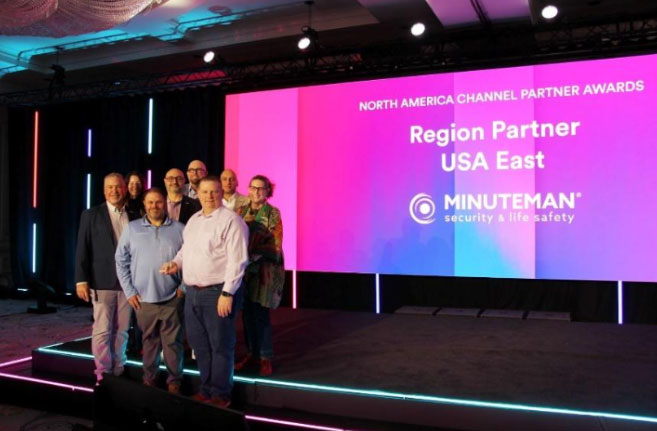
Andover, MA – March 16, 2025– Minuteman Security & Life Safety, the 2025 SDM Systems Integrator of the Year and one of North America’s fastest-growing security and life safety integrators, is honored to announce that it has been awarded the Genetec 2025 Channel Partner Award for USA East Region Partner. This award recognizes top regional sales performance, year-over-year growth, and outstanding service across the Genetec portfolio. Through strong engagement with the Genetec ecosystem, including active use of the Genetec Portal and ongoing CPNA certifications through Genetec University, the Minuteman team continues to demonstrate technical expertise and commitment to delivering best-in-class security solutions.