
Financial institutions have built mature third-party risk management programs. Core processors, cloud providers, and payment platforms face rigorous due diligence before a contract is signed.
They complete questionnaires, review reports, and maintain ongoing monitoring. Disciplined security integrator vetting belongs in that same program.
It rarely gets there. The firm that installs and maintains the physical security environment is often treated as a facilities contractor. Yet its technicians frequently hold some of the most privileged access in the enterprise.
What an Integrator Actually Touches
Think about the footprint of a modern security deployment. Access control servers connect to directory services and HR platforms to provision credentials. Video management systems run on network infrastructure alongside production traffic. Cameras, controllers, readers, and intercoms are networked endpoints, each with its own firmware, credentials, and exposure.
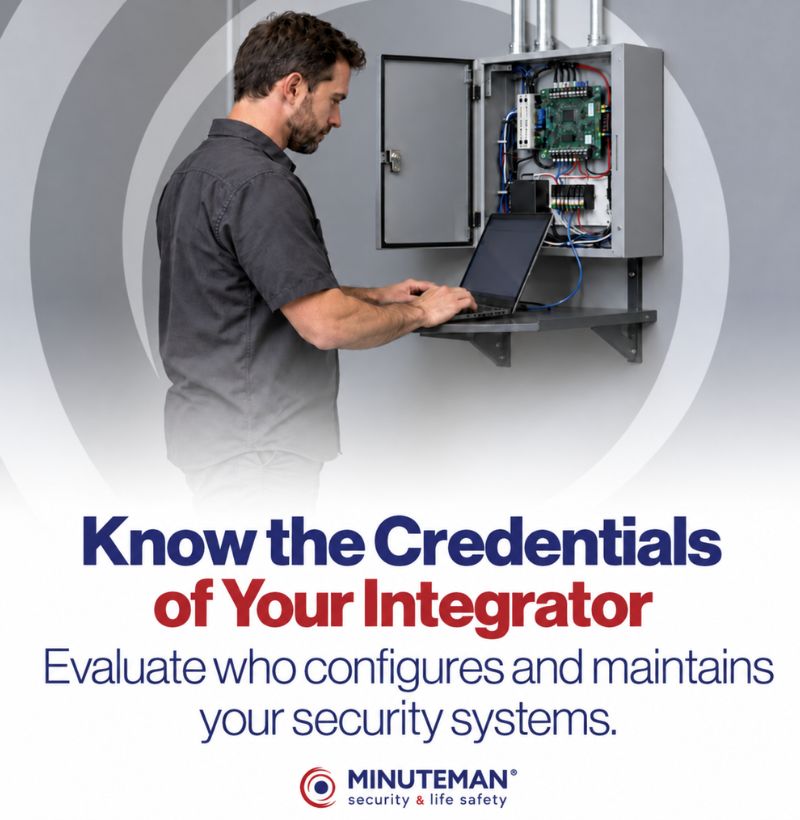
The integrator configuring those systems typically holds administrative rights across all of them. Technicians may retain remote access for support. Their laptops carry configuration files, and their records hold facility drawings, camera coverage maps, door schedules, and the locations of blind spots. The cardholder database alone contains personal information on every employee and contractor.
Access control system security begins with who configures the system. That concentration of access makes the integrator a meaningful part of the institution’s physical security attack surface and, increasingly, its cyber attack surface too.
The Regulatory Frame
The Gramm-Leach-Bliley Act and the banking agencies’ information security standards expect institutions to oversee service providers with access to customer information. FFIEC guidance treats physical controls as a component of a comprehensive information security program, closely tied to identity and access management. Interagency guidance on third-party relationships reinforces the expectation that oversight should scale with the risk a vendor introduces.
An integrator with administrative control over systems that store employee data, protect data halls, and govern who enters a vault room fits squarely within that oversight. GLBA compliance and alignment with FFIEC guidance both argue for evaluating the relationship with the discipline applied to any critical provider.
What Credentials Tell You
Certifications give risk teams a structured, independently verified way to assess an integrator’s controls. Each answers a different question.
A SOC 2 Type II report evaluates whether a service organization’s controls, measured against the AICPA Trust Services Criteria, operated effectively across an extended review period. The distinction matters. A Type I report describes control design at a single point in time. A Type II report tests whether those controls held up in practice, which is the evidence a risk committee actually needs.
ISO 27001 certification confirms that an organization operates a formal information security management system, with risk assessment, defined controls, and continual improvement, verified through audits by an accredited certification body. It speaks directly to how an integrator protects the sensitive data it holds about your environment.
ISO 9001 certification addresses quality management. In a security deployment, that translates into consistent design practices, documented commissioning, controlled changes, and repeatable results across every branch, operations center, and data hall.
Together, these credentials provide objective evidence that an integrator has established formal processes for information security, risk management, quality, and continuous improvement.
Ask The Hard Questions
Credentials open the conversation. A thorough vendor risk assessment goes further.
Request the most recent SOC 2 Type II report and read the scope. Which services and locations were covered? Were exceptions noted? Is a bridge letter available for the period since the report closed? For ISO 27001, review the scope statement on the certificate and confirm it covers the operations serving your account.
Then probe operational controls. How are technician credentials to customer systems issued, protected, and revoked? Is multifactor authentication required for remote access, and are sessions logged? Does the integrator apply least privilege when configuring administrative accounts? How are background checks handled, and do subcontractors meet the same standard?
Video surveillance cybersecurity and device hygiene deserve their own line of inquiry. Ask about hardening baselines, default credential removal, firmware updates, and network segmentation recommendations. Ask how configuration changes are documented and approved. Ask what the integrator commits to in its incident notification terms.
The answers reveal whether security is embedded in the integrator’s daily operations or assembled for the sales process.
Convergence Raises the Stakes
Converged security now shapes financial institution security. Access events feed identity governance. Video supports fraud investigations. Data center security depends on biometric verification, mantraps, and cabinet-level control that must integrate cleanly with IT systems. As physical and cyber environments merge, the integrator’s security posture becomes inseparable from your own.
That convergence also changes how an integrator should be selected. Price, product certifications, and installation capacity still matter, but they are no longer enough. Cybersecurity practices, data handling, privileged-access controls, incident response and governance should be part of the evaluation from the beginning.
How Minuteman Approaches It
Minuteman Security & Life Safety maintains SOC 2 Type II certification along with ISO 27001 and ISO 9001 certifications because protecting a client’s security environment requires more than technical expertise. It requires disciplined processes around information security, quality, access, and accountability, from system design and deployment through ongoing service and support.
Your integrator sits inside your trust boundary. Vet it accordingly.
Contact Minuteman to request our compliance documentation and start a conversation about your security environment.