
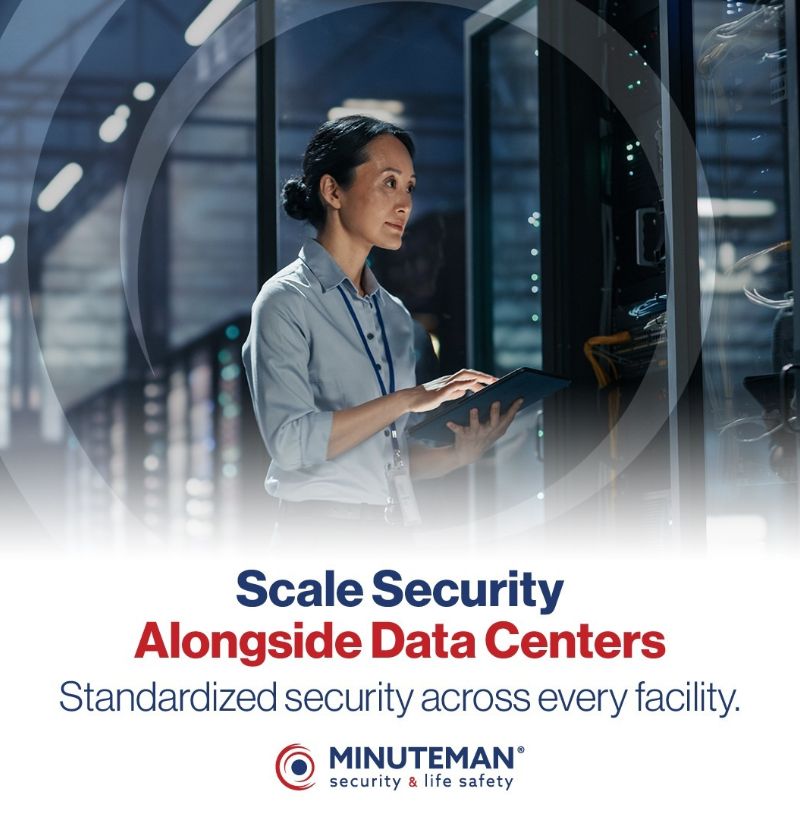
Data center growth is accelerating as demand for AI, cloud computing, and digital infrastructure continues to rise. Operators are expanding existing facilities and developing new campuses to keep pace.
But as data centers grow, maintaining consistent security standards across multiple facilities becomes increasingly complex. Rapid expansion introduces a significant operational bottleneck: physical security fragmentation.
When infrastructure scales faster than governance, operators often end up with a patchwork of disparate access control platforms, isolated video management systems (VMS), varying local installer standards, and inconsistent compliance controls across sites.
In a mission-critical industry where a single breach or audit failure can jeopardize uptime and client trust, securing data centers at the speed of growth requires a deliberate shift in strategy: moving from localized, piecemeal deployments to repeatable, standardized security architecture.
The Hidden Costs of Security Fragmentation
Expanding a data center footprint without strict physical security standardization creates hidden vulnerabilities and operational friction across several key areas:
- Inconsistent Security Policies: A facility in Ashburn may enforce biometric multi-factor authentication and tailgating detection at the cage level, while a newly acquired or rapidly commissioned build in Phoenix relies on legacy card readers and manual visitor logs.
- Operational Blind Spots: Disjointed systems prevent Security Operations Center (SOC) operators from viewing threats holistically. Managing multiple software interfaces slows incident response and increases the risk of human error during critical events.
- Audit and Compliance Friction: Demonstrating compliance across SOC 2 Type II and ISO 27001, or NERC CIP standards becomes a painful, manual exercise when security data sits in disconnected silos across facilities.
- Escalating Lifecycle Costs: Custom, one-off system builds at every location dramatically increase long-term maintenance costs, complicate spare-parts inventories, and make software updates a continuous operational risk.
- Inefficient Service and Preventative Maintenance: When facilities use different security technologies and equipment, servicing becomes more complex and time-consuming and data centers cannot afford any downtime due to mismatched systems. Standardized systems simplify troubleshooting, streamline preventative maintenance, reduce spare-parts requirements, and help technicians resolve issues more efficiently across multiple locations.
The Standardization Blueprint: Scalable Security Infrastructure
Standardization does not mean sacrificing flexibility; it means defining a verified baseline architecture that can be deployed rapidly across any site—whether a regional edge facility, a colocation space, or a massive hyperscale campus.
A scalable physical security standardization strategy relies on three foundational pillars:
1. Unified Enterprise Architecture
Standardizing on open-architecture access control and video management platforms allows security teams to manage identity, credentials, and video analytics across the entire global footprint from a central command pane. Multi-layer credentialing, biometric integration (such as IRIS or facial recognition), license plate recognition (LPR), and thermal perimeter intrusion detection can be configured identically at every location.
2. Pre-Engineered System Templates
By developing standardized equipment specifications, standardized wiring schematics, and modular Security Operations Center (SOC) configurations, operators drastically shorten deployment timelines. Instead of redesigning security for every project, new builds simply execute an established engineering package.
3. Integrated Cyber-Physical Security
Modern physical security systems rely on IP networks and cloud-connected VMS architectures. Standardizing physical security hardware also requires standardizing cybersecurity hardening protocols to ensure every IP camera, door controller, and sensor adheres to rigorous ISO 27001 cybersecurity frameworks.
Operationalizing Standardized Growth: The Minuteman Advantage
Achieving true system standardization across geographically dispersed data centers requires more than purchasing identical hardware—it demands an integration partner capable of executing flawless project delivery at scale.
Minuteman Security & Life Safety approaches data center security from a position of institutionalized precision, technical depth, and nationwide execution capabilities:
- National Delivery Capabilities: With 31 regional offices and more than 500 security professionals nationwide, Minuteman provides local field expertise backed by national reach. Operators gain single-source accountability, ensuring identical build quality whether opening a site in New England or expanding a campus across the Midwest.
- Program Management Office (PMO) Excellence: Minuteman’s certified project management professionals operate through a dedicated PMO framework. The PMO ensures that multi-site rollouts adhere strictly to system design specifications, budget guardrails, and installation timelines, preventing project drift as you scale.
- Deep Technical Expertise & Custom Development: Beyond off-the-shelf installations, Minuteman’s Technical Services Group (TSG) brings deep engineering capabilities. If standard system components need custom middleware to bridge security infrastructure with data center management software (DCIM), Minuteman builds custom integration solutions to maintain a seamless data flow.
- Institutionalized Compliance & Certifications: Minuteman builds compliance directly into system design. With ISO 9001:2015 certified quality processes, ISO 27001 cybersecurity practices, SOC 2 Type II operational certifications, and NERC CIP compliance experience spanning over 2,000 regulated sites, Minuteman ensures your security footprint meets stringent audit demands from day one.
- 24/7/365 Managed Services: Minuteman supports consistent maintenance procedures, proactive system health checks, and faster issue resolution across multiple facilities. Through our remote Security Operations Center (SOC), certified, trained operators can work directly with on-site security teams to troubleshoot and, in many cases, remotely resolve issues without requiring a service technician to travel to the facility. This capability is especially valuable for data centers in remote locations, where dispatching technicians can be time-consuming and costly.
Secure Your Expansion with Confidence
Data center growth will not wait for security teams to catch up. By establishing a standardized, scalable physical security architecture today, operators turn physical security from a reactive build constraint into a proactive driver of operational resilience and market speed.
Ready to standardize security across your data center portfolio? Connect with the mission-critical integration experts at Minuteman Security & Life Safety to audit your current infrastructure and design a scalable security framework built for rapid growth.