
Healthcare and social assistance workers account for roughly 73% of all nonfatal workplace injuries and illnesses due to violence across all industries.
Furthermore, healthcare professionals are roughly 5 times more likely to suffer a workplace violence injury on the job than workers in other sectors. U.S. Bureau of Labor Statistics (BLS)
Healthcare workplace violence remains a persistent threat to caregivers, and hospitals have invested heavily in the human side of prevention. De-escalation training, behavioral risk assessments, clear reporting channels, and multidisciplinary committees now form the foundation of most programs. That work matters enormously. Still, when a nurse in a crowded emergency department signals for help, the outcome hinges on something training cannot supply: how quickly the building itself responds.
Hospital workplace violence prevention lives at the intersection of policy and infrastructure. The policy defines intent. The infrastructure executes it.
Where Response Time Is Won or Lost
Trace the sequence that follows a distress signal. Security must learn that an incident is underway, where it is happening, and what it looks like. Nearby staff may need an alert. Doors along the response path must open for officers, and doors elsewhere may need to secure to contain the situation. Video should follow the event so responders arrive with context.
When those functions run on separate platforms, a dispatcher assembles the incident response by hand, often under extraordinary pressure. Every manual step introduces delay. In a clinical environment, delay carries consequences for the person in danger and for every patient whose care is interrupted. Automation of processes through system integration is the key to success.
Duress Alarms Built for Clinical Reality
A modern duress alarm system extends well past the fixed panic button under a reception desk. Staff duress badges paired with a real-time location system let caregivers call for help discreetly from a patient room, a hallway, or a medication room, transmitting their precise location the moment they press. For staff who move constantly across units, location accuracy determines whether officers arrive at the right door or merely the right floor.
Discretion counts. A caregiver facing an escalating patient or visitor may be unable to reach a phone or wall station without provoking the aggressor. A wearable alert keeps the call for help invisible.
Connecting duress alerts with nurse call platforms widens the circle of awareness, routing notifications to charge nurses and nearby colleagues alongside security.
Access Control as Containment and Clearance
Hospital access control performs a dual function during an incident. It clears a path for responders, and it restricts movement where containment is needed, up to and including a unit-level lockdown. Emergency departments, behavioral health units, pharmacies, and maternity wards each warrant distinct access rules, and a well-designed platform can shift those rules the instant an alarm triggers.
Emergency department security deserves particular attention. The ED operates with open doors around the clock, receives people at their most distressed, and often becomes the point where tension spills over. Controlled entry from waiting areas into treatment zones, secured ambulance bay access, and weapons screening at public entrances reduce exposure and support patient and staff safety without obstructing care.
A visitor management system further strengthens the perimeter. Screening, badging, and the ability to flag individuals with a history of threatening behavior give front-desk teams information they previously lacked.
Video That Follows the Event
Healthcare video surveillance becomes far more useful when it reacts to alarms. An integrated security platform can automatically pull up cameras associated with a duress location, placing live views in front of operators in the security operations center the moment an alert arrives. That situational awareness travels with officers, who approach knowing who is involved and whether a weapon is visible. Recorded footage later supports investigations, incident reporting, and after-action review.
Parking structures and exterior walkways merit the same rigor. Staff leaving an overnight shift should find cameras, lighting, emergency call stations, and intercoms waiting in the spaces where they are most isolated.
The Compliance Dimension
Regulatory expectations have matured. Joint Commission workplace violence requirements for accredited hospitals call for a formal prevention program, incident reporting, data analysis, and ongoing training. OSHA guidance for healthcare employers points in the same direction, and more states have enacted their own legislation.
Integrated healthcare security infrastructure supports those obligations directly. Time-stamped alarm records, access logs, and video create an auditable account of every incident and response. Trend data reveals which units generate the most alarms, at what hours, and under what circumstances, giving the workplace violence prevention committee evidence to guide staffing and design decisions.
Start With the Response Workflow
Technology decisions should follow the response plan, not lead it. Before adding another device or platform, healthcare organizations should map what happens from the moment an incident begins through resolution: who receives the alert, how location is established, what information responders see, which doors or areas need to be controlled, and where manual intervention is still required.
That exercise often reveals that the biggest vulnerability isn’t a missing technology. It’s the gap between systems that were never designed to work together.
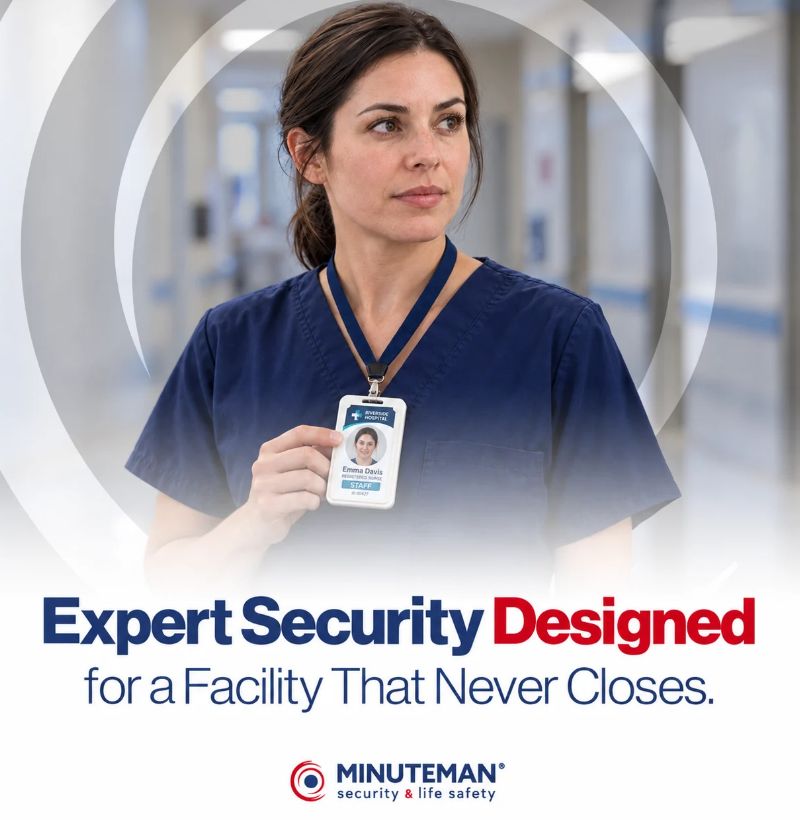
Designing for a Facility That Never Closes
Hospital security systems must be deployed in buildings that never go dark. A qualified healthcare security integrator plans installations around patient care, phases work unit by unit, coordinates with infection control, and preserves continuity for clinical staff throughout. The same discipline applies as health systems expand into satellite clinics and outpatient centers, where standardized platforms keep policies and oversight consistent across every site.
Experience Where It Counts
Minuteman Security & Life Safety helps healthcare organizations evaluate how their people, processes, and security technologies work together during an incident, then designs the infrastructure needed to close the gaps. From assessment and system design through integration, deployment, and long-term support, the goal is simple: make sure the response plan works when it matters.
Training prepares people to respond. Infrastructure determines how fast that response arrives.
Contact Minuteman to schedule a healthcare security assessment and see where your prevention program stands.